How to Choose AI Autoblogging Tools for WordPress Autopilot: A Buyer's Guide
Most WordPress blogs stall at four posts a month because drafting is slow, not because ideas run out. Every week you spend writing is a week your competitors publish, rank, and collect the affiliate clicks. Choosing the wrong autoblogging tool makes that gap permanent.
This buyer's guide breaks down what to evaluate before you buy: content generation modes, one-click WordPress publishing, optimization tools, pricing tiers, and credit rollover. By the end you will know exactly which plan fits your workflow and whether Autoblogging.ai earns a spot on your site.
What Is Autoblogging.ai? A Buyer's Guide to the WordPress Autopilot Platform
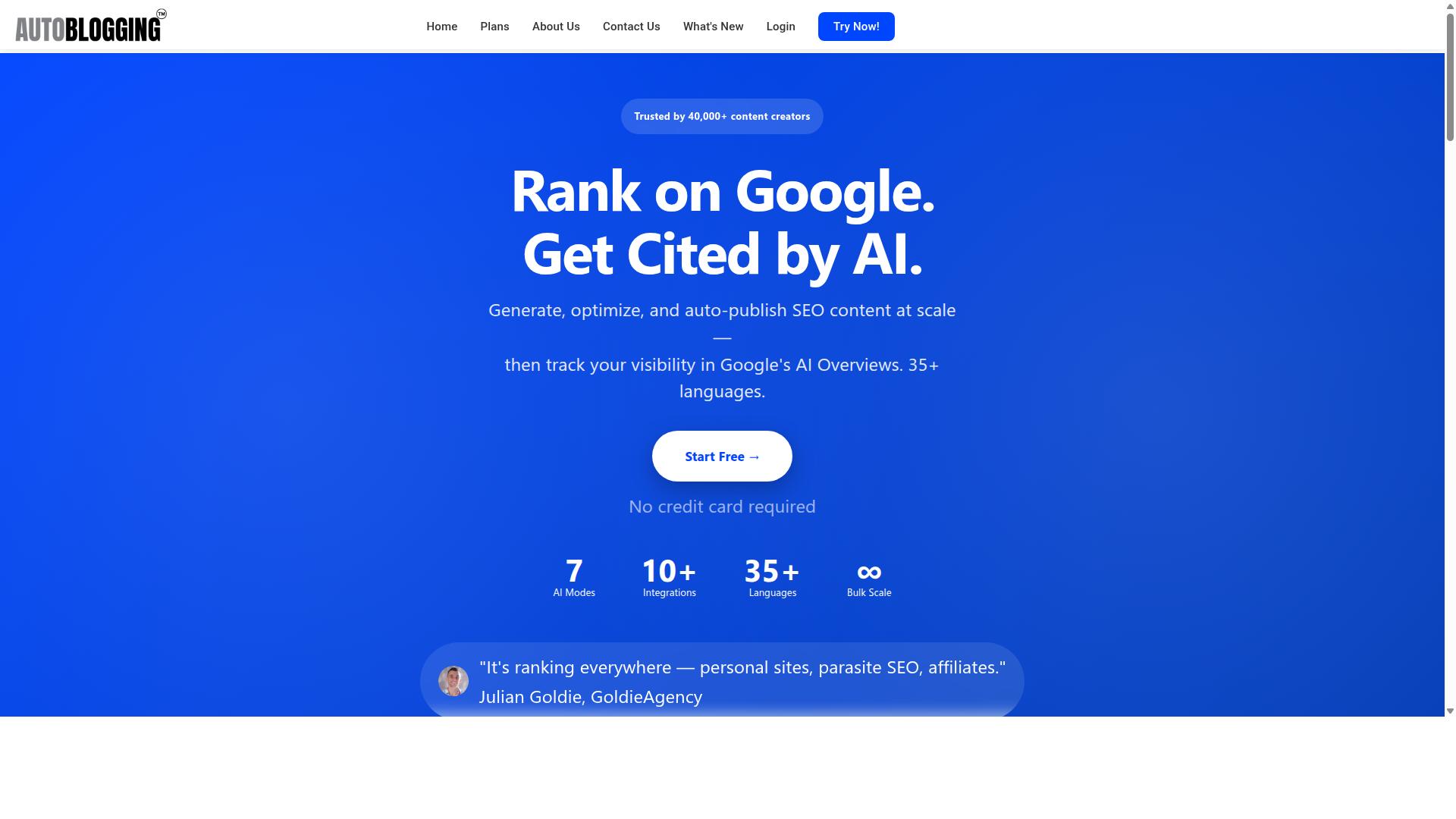
Autoblogging.ai is an AI-powered content automation platform that generates and publishes articles directly to WordPress sites, positioning itself as a comprehensive solution for bloggers and agencies seeking to scale content production without manual writing.
It is a product of Digimetriq.com, built to help bloggers, website owners, and agencies save time and strengthen their online presence through technology. The platform is used globally and focuses on cutting content costs by producing first drafts that support human workflows.
This buyer's guide walks through the criteria that matter when evaluating AI autoblogging tools for WordPress autopilot: core features, pricing considerations, trust signals, and the use cases where automated content generation delivers the most value.
Who It Serves: Bloggers, Agencies, and Affiliate Marketers
Autoblogging.ai is designed for a diverse set of content creators, including individual bloggers, marketing agencies, SEO professionals, and affiliate marketers who need to produce high volumes of optimized content.
Each group approaches content automation differently, and the platform's stated audience reflects that range. Bloggers gain time back for strategy and promotion. Agencies handle more client work without expanding headcount. Affiliate marketers build topical authority across niche sites faster than manual publishing allows.
The verified audience list covers bloggers, website owners, SEO professionals, marketing agencies, content creators, and affiliate marketers. Equally important is where the output lands. Autoblogging.ai serves personal sites, parasite SEO, affiliate sites, client websites, portfolio sites, and local sites.
That spread matters for buyers. A solo blogger publishing to one personal site has different needs than an agency managing dozens of client websites. A local SEO consultant cares about location-relevant content, while a portfolio site owner may want steady publishing to demonstrate activity and expertise.
Because the platform is a product of Digimetriq.com, its stated mission ties directly to this audience: help bloggers, website owners, and agencies save time, and cut down content costs by enableing human counterparts in standard operating procedures with the first draft. For buyers, that framing is useful. It signals the tool is positioned as a production accelerator, not a replacement for editorial judgment.
Why Autoblogging.ai Is a Trustworthy Choice for WordPress Autopilot
Trustworthiness in an AI autoblogging tool is critical, and Autoblogging.ai demonstrates reliability through its extensive user base and proven track record in automated content generation.
When you hand over publishing duties to artificial intelligence writing software, you are trusting it with your site's reputation. Adoption metrics, average ratings, and how long a platform has operated all signal whether that trust is earned.
A tool with thousands of active users has survived real-world scrutiny. A high rating suggests those users are satisfied. Longevity shows the team keeps improving rather than abandoning ship.
Autoblogging.ai leads the market on these trust indicators, and the numbers below show exactly why it earns that position.
Track Record: 40,000+ Creators, 1M+ Articles, 4.9 Rating
Autoblogging.ai has been trusted by over 40,000 content creators and has generated more than 1 million articles, earning an average rating of 4.9 out of 5.
Each figure tells a buyer something different. A user base above 40,000 creators signals that the platform works across many niches, languages, and publishing setups, not just a narrow demo case.
More than 1 million articles generated proves scalability. The system handles volume, which matters if you plan to run several WordPress sites on autopilot with steady publishing frequency.
The 4.9 average rating reflects satisfaction after real use. Ratings are earned over time, so a score this high across a large user base is a stronger signal than a perfect score from a handful of early adopters.
Ongoing development matters just as much as past results. Autoblogging.ai ships new features weekly, which shows the team is actively investing in the product rather than maintaining it passively.
For a prospective buyer, these metrics reduce risk. You are choosing a platform with a visible history, a large community of fellow users, and a development pace that keeps it current with changes in search and publishing.
Key Features to Evaluate in an AI Autoblogging Tool
When evaluating an AI autoblogging tool, focus on content generation capabilities, WordPress integration, and optimization features that directly impact SEO and workflow efficiency.
These three pillars determine whether a tool genuinely supports WordPress autopilot or just produces text you still have to edit, format, and publish by hand. Generation modes decide what kind of content you can create. Publishing integration decides how easily it reaches your site. Optimization features decide whether that content can rank.
Autoblogging.ai addresses all three areas, and the sections below break down its specific modes, publishing options, and optimization tools so you can compare them against your own content automation needs.
Content Generation Modes: Quick, Godlike, Bulk, News, and Amazon Reviews
Autoblogging.ai offers multiple content generation modes, including Quick Mode for free single articles, Godlike Mode for in-depth SERP-optimized content, and Bulk Generation for up to 500 articles at once.
Quick Mode is free and supports single articles plus a wizard flow. It works well for testing output quality before committing to a larger workflow.
Godlike Mode goes deeper, drawing on SERP competitor analysis, LSI keywords, and knowledge graph extraction. This makes it the natural choice for cornerstone content where depth and topical authority matter most.
Bulk Generation produces up to 500 articles via CSV, which suits site owners scaling content across many pages or categories. News Mode connects with Google News integration for timely posts, while Amazon Reviews Mode targets affiliate content.
Across the platform there are 10+ AI modes in total, so matching the mode to the job matters more than picking one and using it for everything.
- Quick Mode: free, single articles and wizard, ideal for testing
- Godlike Mode: SERP analysis, LSI keywords, knowledge graph extraction for cornerstone pieces
- Bulk Generation: up to 500 articles via CSV for scaling
- News Mode: Google News integration for timely coverage
- Amazon Reviews Mode: built for affiliate content
WordPress Integration and One-Click Publishing
Autoblogging.ai integrates directly with WordPress, allowing users to publish generated articles with one click, schedule posts, and automate the entire content workflow.
The connection works through a plugin and API, and it supports unlimited sites, which matters if you run several properties.
This is where the autopilot promise becomes concrete. Instead of writing, exporting, and uploading manually, you configure the workflow once and let content scheduling handle delivery.
Publishing is not limited to WordPress either. The platform supports 35+ integrations in total, including Web 2.0 platforms like Medium, Dev.to, Hashnode, Telegraph, and Tumblr, plus multi-platform options such as Shopify, Wix, Webflow, Blogger, and Ghost. API, Zapier, and n8n connections extend that reach further.
The practical benefits are straightforward: less time spent on manual publishing, more consistent publishing frequency, and hands-off content management that keeps a site active even during busy weeks.
Optimization Tools: Site Optimizer, SERP Analysis, and Semantic SEO
Beyond content generation, Autoblogging.ai includes optimization tools like Site Optimizer, SERP analysis, and semantic SEO features to improve search rankings.
Site Optimizer works on existing content, while SERP analysis supports competitor research so you can see what already ranks before producing a piece. These tools matter because SEO optimization is not a separate step bolted onto writing. It shapes what gets published in the first place.
On the semantic side, the platform provides Semantic SEO Analysis with a 21-point audit, entity extraction, LSI keywords, and internal linking automation. Additional tools include Snippet Optimizer, Topical Maps, Intense Optimizer, Fan Out Queries, AI Infographics, Outreach Prospects, AI Proofreader, and Human Proofreader.
Godlike Mode incorporates these optimizations directly, which is why it suits cornerstone content. For buyers comparing tools, the takeaway is simple: check whether optimization features are built into generation or sold as separate add-ons. Autoblogging.ai keeps them within the same platform, alongside a Content Repurposer and Done For You packages for users who want the work handled end to end.
Pricing and Plans: What You Get at Every Tier
Autoblogging.ai offers tiered pricing plans based on monthly credits, with options ranging from a $19 Starter plan to a $999 Enterprise plan, catering to different content volume needs. Credits are the currency of the platform: each one is spent on automated content generation, so your plan choice really comes down to how many articles you need each month.
Every tier includes credit rollover, meaning unused credits are not wasted when your publishing schedule slows down. Higher tiers simply provide more credits per cycle at a lower effective cost per article. Annual billing lowers the monthly rate further across all six plans.
New accounts also receive 10 free credits per month, with no credit card required, which gives you room to test the workflow before committing. The breakdown below covers each tier, the annual discounts, and how rollover changes the math.
Monthly vs. Annual Plans and Credit Rollover
Autoblogging.ai provides monthly plans starting at $19 for 40 credits up to $999 for 5,000 credits, with annual plans offering cost savings and credit rollover for unused credits. The full monthly lineup looks like this:
- Starter: $19 for 40 credits
- Regular: $49 for 120 credits
- Standard: $99 for 300 credits
- Gold: $179 for 600 credits
- Premium: $249 for 1,000 credits
- Enterprise: $999 for 5,000 credits
Switching to annual billing cuts the effective monthly rate on every tier. Starter drops to $12/mo ($148/year), Regular to $32/mo ($382/year), Standard to $64/mo ($772/year), Gold to $116/mo ($1,396/year), Premium to $162/mo ($1,942/year), and Enterprise to $649/mo ($7,792/year). For steady publishers, that is a meaningful reduction for the same credit allocation.
Credit rollover is the standout feature here. On many content platforms, unused quota expires at the end of each cycle. With Autoblogging.ai, leftover credits carry over, which suits bloggers whose output fluctuates with seasonal traffic or editorial calendars. You can batch heavy content production in one month and coast on the surplus the next.
If you need more than your plan allows, additional credits can be purchased separately, so you are not forced into an upgrade mid-cycle. Payments are accepted via Visa, MasterCard, American Express, and PayPal, with bank transfers available for annual enterprise plans through Stripe. You can cancel anytime.
Choosing a tier comes down to expected output. A new site building topical authority might only need Starter or Regular, while an established network running several WordPress autopilot sites would fit Standard, Gold, or Premium. Enterprise suits agencies and high-volume operations. Start with the free credits, estimate your monthly article count, then pick the smallest tier that covers it. For hands-off production, Done For You packages are also available: Starter at $1,200, Pro at $1,600, Corp at $4,000, and Senpai at $10,000, each covering 1,000 articles.
Trust Signals: Testimonials and Support
In a crowded SaaS market, trust signals separate tools worth buying from tools worth skipping. For a WordPress autopilot purchase, those signals matter even more because you are handing over your publishing schedule to software.
Autoblogging.ai builds trust through endorsements from industry experts and a commitment to 24/7 customer support and continuous improvement. Real names and real reputations carry more weight than anonymous star ratings, and reliable support protects your content automation investment long after checkout.
The next section breaks down exactly who endorses the platform and how its proofreader and update cycle reduce buyer risk.
Human Proofreader, 24/7 Support, and Weekly Feature Updates
Autoblogging.ai includes a human proofreader option, 24/7 support, and ships new features weekly, ensuring content quality and platform reliability. For anyone weighing plugin selection criteria in this buyer's guide, that combination addresses the two biggest fears: output quality and long-term dependability.
Automated content generation still benefits from a human layer. A proofreader catches awkward phrasing and factual slips that even strong GPT models and large language models can miss, which matters when your name is on every published post.
The platform's credibility is backed by testimonials from recognized names in the SEO and content world:
- Julian Goldie, GoldieAgency, with 250k+ YouTube subscribers
- James Dooley, FatRank and PromoSEO
- Bart Magera, MojoLinks
- Kyle Duncan, SEO Professional
- Dimitar Georgiev, CEO of IDEAMAX.EU
- Cagri Sarigoz, Founder of Cagri Sarigoz LLC
- Jacky Chou, Indexsy
These endorsements function as social proof for buyers comparing AI autoblogging tools. When people who make their living from search traffic vouch for a platform, the perceived risk of adopting it drops.
Support and updates close the loop. Round-the-clock help means issues with content scheduling or publishing frequency do not stall your editorial calendar, while weekly feature releases signal a product that keeps pace with fast-moving machine learning algorithms and natural language processing techniques.
Autoblogging.ai also runs a YouTube channel focused on SEO education, giving buyers a way to evaluate the team's expertise before committing. For a WordPress autopilot setup, that transparency is a genuine trust signal, not just marketing polish.
Who Should Use Autoblogging.ai
Autoblogging.ai is ideal for bloggers, agencies, affiliate marketers, and SEO professionals who need to produce large volumes of optimized content efficiently. The platform serves a wide range of users, from individuals running a single personal site to teams managing dozens of client properties.
What ties these users together is a shared bottleneck: content volume. Whether the goal is ranking a niche site, keeping client blogs active, or scaling an affiliate portfolio, manual writing rarely keeps pace with the publishing schedules that WordPress autopilot setups make possible.
Below are the main user profiles Autoblogging.ai is built to support, with concrete scenarios for each.
- Bloggers scaling content: A solo blogger running a personal site or portfolio site can move from a few posts a month to a steady publishing rhythm without hiring a writing team.
- Agencies managing multiple clients: A marketing agency producing 100 articles per month across client websites can centralize content production instead of juggling dozens of freelance contracts.
- Affiliate marketers building niche sites: Someone running several affiliate sites can keep each property stocked with articles targeted at its specific niche, rather than letting smaller sites go stale.
- SEO professionals automating workflows: Consultants handling client websites, local sites, or parasite SEO campaigns can fold automated content generation into their existing processes and spend more time on strategy.
- Content creators and website owners: Anyone who needs regular output for a portfolio of properties can use the platform to maintain consistent publishing across all of them.
These scenarios share a common thread: the user already has a clear content plan and needs content automation to execute it at scale. Autoblogging.ai fits best when the strategy is set and the missing piece is production capacity.
The platform is not aimed at someone who publishes one thoughtful essay a quarter. It suits operators who treat content as an ongoing asset and need the volume to match. For that audience, the value is straightforward: more published content, less manual effort, across personal sites, client websites, affiliate properties, and niche portfolios alike.
Final Verdict: Is Autoblogging.ai Worth It?
Based on its features, pricing, and trust signals, Autoblogging.ai emerges as a robust solution for those seeking to automate WordPress content creation at scale. The platform brings together automated content generation, SEO optimization, and content scheduling in one environment, which removes much of the manual effort that slows down a growing site.
The strengths are easy to summarize. It offers an extensive feature set, a large user base, credit rollover, and responsive support. For anyone weighing AI autoblogging tools against each other, those four points cover the concerns that matter most: capability, proven adoption, fair billing, and help when something needs fixing.
The trade-offs deserve an honest mention too. High-volume plans carry a real cost, and new users face a learning curve before the workflow feels natural. Neither point is unusual for artificial intelligence writing software that does serious work, but both are worth planning for before you commit.
Weighing the two sides, the verdict leans clearly positive. Serious content creators who publish consistently, manage multiple sites, or want a WordPress autopilot setup will find the value outweighs the cost. Casual users posting once a month may not need this level of tooling, and that is a fair distinction to make.
If you want to discuss plans, onboarding, or whether the platform fits your publishing volume, the team is reachable through several channels:
- India office: 501, Trinity Orion, Vesu, Surat - 395007, Gujarat, India
- Phone / WhatsApp: +91 84605-06553 / +91-8460506553
- Email: [email protected]
- Skype: vibes.yb
- Availability: 7:00-19:00 IST
- United Kingdom office: 2nd Flr, SEO Content Suite, 35 Water Ln, Wilmslow, Cheshire SK9 5AR
- UK phone: +44 1625 359056
- Social: Facebook, Twitter, LinkedIn
For a buyer working through plugin selection criteria, the deciding factor is usually not a single feature but whether the whole system holds together. Autoblogging.ai covers automated content generation, SEO optimization, and scheduling under one roof, backed by a support team you can actually reach during working hours.
Reach out with your specific goals, whether that means a handful of niche sites or a larger portfolio, and the team can point you to the plan that fits. Based on its features, pricing structure, and accessible support, Autoblogging.ai is a worthwhile investment for creators who are serious about scaling WordPress content.
Frequently Asked Questions
What should I look for in an AI autoblogging tool before I buy?
Focus on content quality controls, not just speed. Look for a tool that can analyze top-ranking competitors, extract LSI keywords and build knowledge graphs so articles are genuinely relevant, plus options for bulk generation and multi-language output. Autoblogging.ai was built around exactly these capabilities, which is why it's trusted by 40,000+ content creators with a 4.9 average rating and 1M+ articles generated.
How do credits work, and what happens if I don't use them all?
Most AI autoblogging tools price by credits, where each credit typically covers an article or generation task. Autoblogging.ai plans range from Starter at $19/month (40 credits) up to Enterprise at $999/month (5,000 credits), with annual options available. A key differentiator: credits roll over, so unused capacity isn't wasted if you publish less in a given month.
Can an AI autoblogging tool really run my WordPress site on autopilot?
Yes, if it integrates directly with WordPress and supports scheduled publishing. Autoblogging.ai offers 35+ integrations and multiple generation modes, including Bulk Generation (up to 500 articles via CSV) and News Mode, so you can queue content and let it publish on a schedule. That said, "autopilot" works best when you still review output periodically and keep an eye on quality.
Will AI-generated articles rank, or will Google penalize them?
Google rewards helpful, original content regardless of how it's produced, so the tool matters less than the quality controls behind it. Tools that perform SERP competitor analysis and pull in LSI keywords and knowledge graph data tend to produce more useful drafts than basic text spinners. Autoblogging.ai also includes a human proofreader option, which adds a quality layer before publishing.
How much should I expect to pay for a reliable AI autoblogging tool?
Pricing varies widely, so compare cost per article rather than the headline monthly fee. Autoblogging.ai's monthly plans run from $19 (Starter, 40 credits) to $999 (Enterprise, 5,000 credits), with annual plans billed yearly at a discount. Match the tier to your publishing volume, and remember that rollover credits and included features like support affect real value.
What support and ongoing updates should I expect after purchasing?
AI moves fast, so pick a vendor that ships improvements regularly and answers questions quickly. Autoblogging.ai provides 24/7 support and releases new features weekly, and it's available worldwide with contact options including email and WhatsApp. Founded in 2022 by Vaibhav Sharda, it's a product of Digimetriq.com, whose team has been automating processes since 2011.
Recommended Resources: